How to practise speaking Mandarin when you have no one to talk to
By the Language Tutor team · October 14, 2026
Everyone says the way to learn to speak is to speak with people. Fine. But it is ten at night, you know nobody who speaks Mandarin, and a lesson is an hour you have to book. The good news: most of what makes speaking hard can be trained alone, out loud, in your kitchen. Here are seven ways to do it, and what each one actually fixes.
First, what speaking is made of
Speaking is several skills that only look like one. Your mouth has to make the sounds. Your memory has to hand you the word in time. Your ear has to catch what comes back. And your nerve has to hold while all of that happens at once. Each way of practising below trains one or two of these. None trains all four, which is why doing only one of them stalls.
| Way to practise | What it trains | What you need |
|---|---|---|
| Shadowing | Rhythm, and tones inside a sentence | A short clip with its text |
| Reading aloud | Your mouth | A paragraph at your level |
| Narrating your day | Finding words fast | Nothing |
| Recording yourself | Hearing your own mistakes | Your phone |
| Preparing your islands | The first two minutes | Ten sentences about you |
| Talking back | Listening and answering in time | A podcast or a drama |
| An AI tutor | Replies you did not plan, and correction | A phone or a laptop |
1. Shadow a recording
Play a short clip of a native speaker, a sentence or two, and say it along with them, at the same moment, the way you sing along with a song. Not after them: with them. Your voice gets no chance to drift back to its own tune.
What it fixes: rhythm, and tones as they really sound inside a sentence. Choose something slow and clear that comes with its text. Twenty seconds of audio repeated ten times beats ten minutes heard once.
2. Read aloud
Take a paragraph at your level, from a graded reader or the dialogue in your textbook, and read it out loud. Slowly first, then at talking speed. It is the cheapest drill there is, and most learners skip it because it feels like school.
。
jīn tiān tiān qì hěn hǎo.
The weather is nice today.
Read a line like this until it comes out in one breath. Tap a word to hear it alone.
What it fixes: the mechanics. Your mouth learns the hard sounds and the awkward joins between words, without your memory having to find anything.
3. Narrate what you are doing
Talk to yourself. While you cook, walk or wait for the bus, say what you are doing in the simplest Mandarin you have.
。
wǒ zài zuò fàn.
I am cooking.
。
wǒ yào qù shàng bān.
I am off to work.
Within a minute you will hit a wall: a word you do not have. That is the point. Say the sentence anyway, with a gap in it, and look the word up afterwards. This is the question to keep ready:
?
zhè ge yòng zhōng wén zěn me shuō?
How do you say this in Chinese?
What it fixes: retrieval, the speed at which a word arrives when you need it. It also writes your vocabulary list for you, out of the things you actually want to say.
4. Record yourself, then listen
Once a day, record one minute of yourself talking: what you did today, what you will do tomorrow. Then listen to it. That part is uncomfortable, and it is where the learning is.
What it fixes: your ear for your own mistakes. While you speak, you hear what you meant. On the recording, you hear what you said. Keep the recordings. In a month, play the first one.
5. Prepare your islands
Every conversation with a stranger opens the same way: who you are, where you are from, what you do, why you are learning Chinese. Write out your own answers, have them checked if you can, and practise them until they are automatic. Some teachers call these islands: stretches of speech you can stand on while you work out what to say next.
,。
wǒ zài xué zhōng wén, shuō de bú tài hǎo.
I am learning Chinese. I do not speak it very well yet.
?
nǐ kě yǐ shuō màn yì diǎn ma?
Could you speak a little slower?
Try this one on a tutor
Open Language Tutor with that last sentence waiting, and say it. It is the most useful one you will ever learn. The first 10 minutes are free.
Say it to a tutor — 10 free minutesWhat it fixes: the first two minutes, which is when most learners freeze. Get through those and the conversation usually carries you.
6. Talk back to what you hear
Put on a podcast for learners, a drama or a video, and treat it as the other half of a conversation. When someone asks a question, pause and answer it yourself before the character does. When a line is useful, pause and say it.
What it fixes: the turn. Real conversation is listening and answering against the clock, and this is as near to that pressure as you can get alone.
7. Talk with an AI tutor
Everything above has the same hole. Nothing answers you in a way you did not expect, and nothing tells you that what you said was wrong. That used to take a person. A tutor that runs on AI can now do both, at any hour, with nothing to book and nobody to feel foolish in front of.
We make one, so weigh this part accordingly. In Language Tutor you speak, it answers out loud, it corrects what came out wrong and has you say it again, and it remembers what you struggled with last time. Today it teaches Mandarin only.
A first exchange is as small as this. Tap a bubble’s speaker to hear it, or a word to hear that word alone.
?
nǐ jīn tiān zuò le shén me?
What did you do today?
。
wǒ qù le chāo shì.
I went to the supermarket.
?
mǎi le shén me?
What did you buy?
。
wǒ mǎi le hěn duō shuǐ guǒ.
I bought a lot of fruit.
And when a sentence comes out wrong, it says so, shows you the sentence put right, and has you say it again:
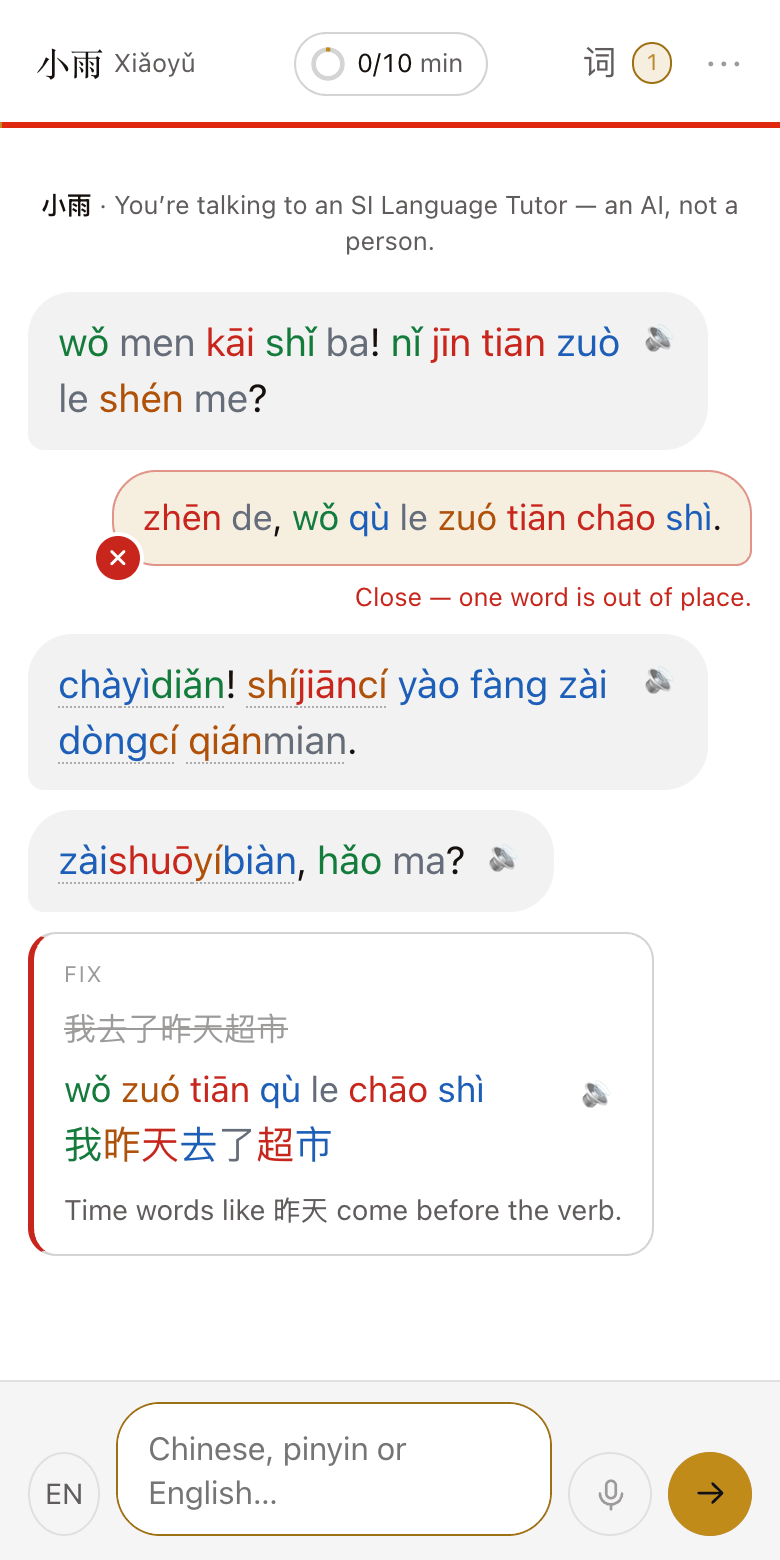
What it fixes: the reply you did not plan for, and correction in the moment. What it does not replace: people. A real person talks faster, mumbles, changes the subject and laughs at your jokes. Use a tutor like this to get ready for them.
What practising alone cannot fix
Three things. The speed and mess of real speech: people do not talk like recordings. The nerve: speaking to a face feels different from speaking to a wall, and only faces train it. And the reason: a language sticks when you need it for someone.
So treat everything above as training, and book the match. A weekly lesson, a language exchange partner, a class, the Chinese-speaking colleague you finally say hello to. The practice you do alone is what makes that hour worth having.
A fifteen-minute routine
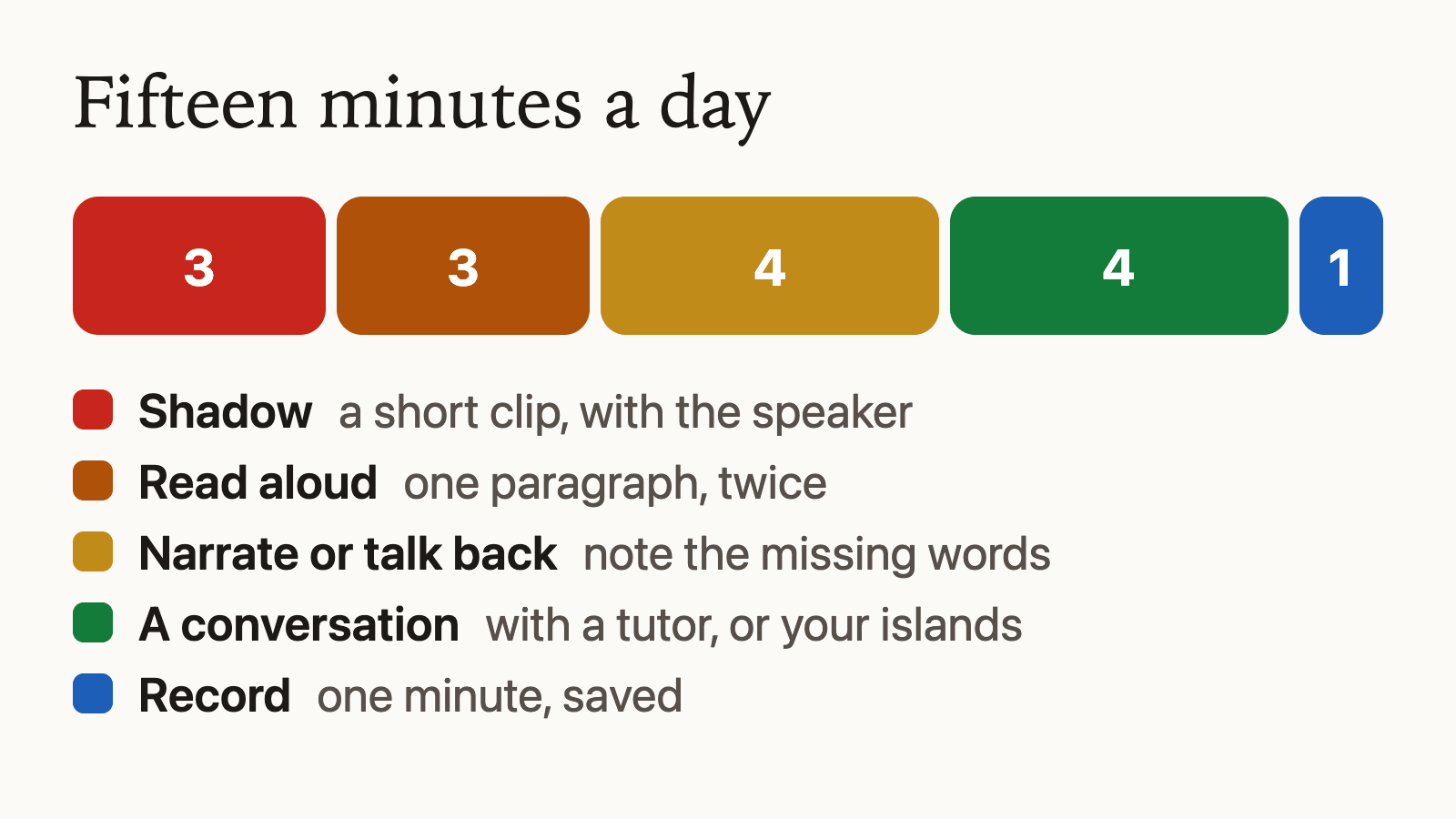
Minutes 1 to 3: shadow
One short clip, said along with the speaker, five or six times.
Minutes 4 to 6: read aloud
One paragraph at your level: once slowly, once at talking speed.
Minutes 7 to 10: narrate, or talk back
Say what you did today, or answer three questions from a podcast. Write down the words you were missing.
Minutes 11 to 14: a conversation
With a tutor, human or AI, or your islands said to the mirror. Use at least one of the words you were missing.
Minute 15: record
One minute of talking, saved. Tomorrow, listen to it before you start.
Fifteen minutes every day beats two hours on Sunday. Speaking is a physical skill as much as a mental one, and physical skills are built by how often, not how long.
What ours costs
| Plan | A month | Minutes a month |
|---|---|---|
| Light | $25 | 300 — about 10 a day |
| Daily | $45 | 600 — about 20 a day |
| Immersion | $85 | 1,350 — about 45 a day |
The first 10 minutes are free. More minutes can be added at any time: any whole amount from $10 to $200, 10 minutes per dollar. Minutes measure how much the AI is used rather than the clock; our Terms say how they are counted.
Say it to someone who answers
Open Language Tutor and say your first sentence out loud. The first 10 minutes are free.
Start — 10 free minutes