Mandarin tones: why you keep getting them wrong, and a ten-minute daily drill
By the Language Tutor team · October 14, 2026
You can recite mā, má, mǎ, mà. You may even get each one right on its own. Then you say a whole sentence, and the person in front of you tilts their head. That gap, between knowing the tones and using them, is where almost every learner gets stuck. It has causes, and each one can be fixed.
The four tones, and the one nobody counts
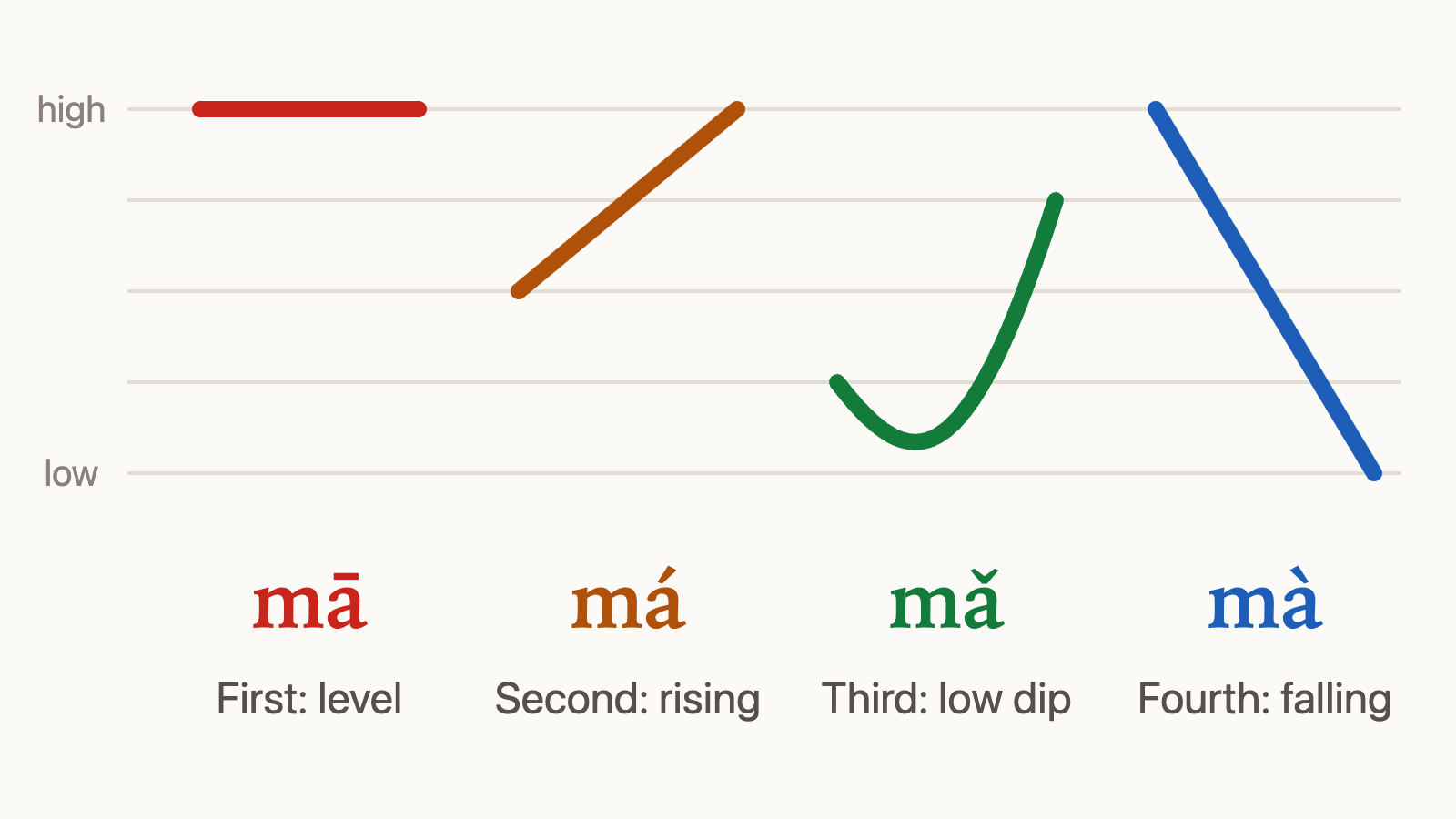
Tap each one and listen. It is the same syllable four times: only the path your voice takes changes.
| Tone | What your voice does | Example |
|---|---|---|
| First | Stays high and level, like holding a note | mā mother |
| Second | Rises from the middle to the top, like asking “what?” | má hemp |
| Third | Stays low. Alone, or at the end of a phrase, it dips and comes back up | mǎ horse |
| Fourth | Drops fast from the top, like a firm “no” | mà to scold |
| Neutral | Short and light, with no shape of its own | ma turns a sentence into a question |
One syllable, five words. English uses pitch too, but for feeling: surprise, doubt, a question. Mandarin uses it to tell words apart. So the habit you have built over a lifetime of speaking is the very thing in your way.
Why you keep getting them wrong
1. You practised single syllables, but people speak in pairs
Most Mandarin words are two syllables long. A tone on its own is easy. The hard part is getting from one tone to the next without the first one bending the second. A high first tone into a rising second, a falling fourth into another fourth: each join is a small movement of its own, and it has to be learned as a movement, the way a guitarist learns a chord change and not two separate chords.
2. The third tone you were taught is the rare one
Textbooks draw the third tone as a deep dip that climbs back up. In real speech it does that only when it stands alone or ends a phrase. Everywhere else it is simply low: it starts low, stays low, and the next syllable takes over. If you swoop on every third tone, your sentences lurch, and the tones on either side get pulled off course.
And when two third tones meet, the first one turns into a rising tone. The first word every learner meets does exactly this:
nǐ hǎo
hello
Written with two third tones. Said as a second and a third: ní hǎo.
3. Two small words change their tone
不 (not) is a fourth tone, until it comes before another fourth tone; then it rises. 一 (one) is a first tone when you count. Before a first, second or third tone it falls, and before a fourth it rises. Nobody works this out in the middle of a sentence. You learn the common combinations as whole sounds.
| Written | Meaning | What happened |
|---|---|---|
| bùhǎo | not good | 不 keeps its fourth tone |
| búshì | is not | 不 rises before a fourth tone |
| yìtiān | one day | 一 falls before a first tone |
| yígè | one (of something) | 一 rises before a fourth tone |
4. English melody leaks in
In English your voice goes up at the end of a question and comes down at the end of a statement. Do that in Mandarin and you have changed the last word. Learners turn the final syllable of a question into a second tone, and let the end of every statement fall like a fourth. In Mandarin the question is carried by a word, not by the tune:
?
nǐ shì lǎo shī ma?
Are you a teacher?
The question lives in 吗. 师 stays high and level. It does not rise.
5. Your range is too narrow
A new language makes people quiet and careful, and careful voices go flat. But a first tone has to be properly high, and a fourth has to start high in order to fall. If your whole voice sits in the middle, first and second blur together, and so do third and fourth. Tones need room.
6. You cannot hear yourself
While you speak, your attention is on finding the words. You hear what you meant to say, not what came out. Until something outside you plays it back, whether a recording, a teacher or a patient friend, the same mistakes repeat.
Can you hear them yet?
Before your mouth can make a tone, your ear has to tell it from the others. Six sounds, one at a time: play each, then pick the tone you heard.
Ear test
Listen, then pick the tone you heard.
A ten-minute daily drill
Ten minutes, every day, out loud. Standing up helps. So does being a little louder than feels polite. You need a way to hear a model of each word (a dictionary app or a text-to-speech voice will do) and a way to record yourself (your phone).
Minute 1: find your range
Hum the lowest note you can comfortably talk on, then the highest. Say mā on the high one. Say the low part of mǎ on the low one. The distance between them is the room your tones have, and beginners rarely use all of it.
Minutes 2 and 3: four tones, exaggerated
Take one syllable through all four tones, bigger than feels natural: mā, má, mǎ, mà. Then tāng, táng, tǎng, tàng. Trace each shape in the air with your hand as you say it. It feels silly, and it works: your hand keeps your voice honest.
Minutes 4 to 7: tone pairs
This is the heart of it. Take one row of the table below and say each word five times: listen to the model, say it, listen again. Take a different row tomorrow. In four days you have covered every combination. Then start over, faster.
Minutes 8 and 9: one sentence, shadowed
Choose a single sentence. Play the model and speak along with it, at the same moment, three times. Then say it alone. Shadowing makes your pitch follow someone else’s instead of drifting back to an English tune.
Minute 10: record, compare, choose tomorrow’s first word
Record yourself saying today’s row. Play the model, then your recording, word by word. Pick the word that sounded least like the model. It opens tomorrow’s drill.
The sixteen pairs
The row is the first syllable’s tone. The column is the second syllable’s. Tap any word to hear it.
| First syllable | then first | then second | then third | then fourth |
|---|---|---|---|---|
| First | jīntiān today | zhōngguó China | hēshuǐ to drink water | gāoxìng happy |
| Second | míngtiān tomorrow | xuéxí to study | píngguǒ apple | xuéxiào school |
| Third | lǎoshī teacher | lǚyóu to travel | nǐhǎo hello | zǎofàn breakfast |
| Fourth | dàjiā everyone | dàxué university | diànnǎo computer | zàijiàn goodbye |
A sentence to start with
。
wǒ míng tiān qù xué xiào.
I am going to school tomorrow.
Third, second, first, fourth, second, fourth: six syllables that use every tone.
Say it to your tutor
Open Language Tutor with this sentence waiting. Say it out loud and hear what comes back. The first 10 minutes are free.
Say it to a tutor — 10 free minutesHow you know it is working
- You catch your own mistake a beat after you make it. This comes first, before you can stop making it.
- People answer what you said instead of asking you to say it again.
- New words arrive with their tones attached, as one sound, and not as a syllable plus a number to remember.
None of this takes talent or a musical ear. It takes a small amount of loud, slightly embarrassing practice, repeated daily, and something that tells you the truth about how you sounded.
Where a tutor fits
The drill builds the movements. Conversation is where they have to survive, while you are also hunting for words and listening for the answer. That is a tutor’s job: to keep you talking, to notice when a tone changed the word, and to have you say it again right then.
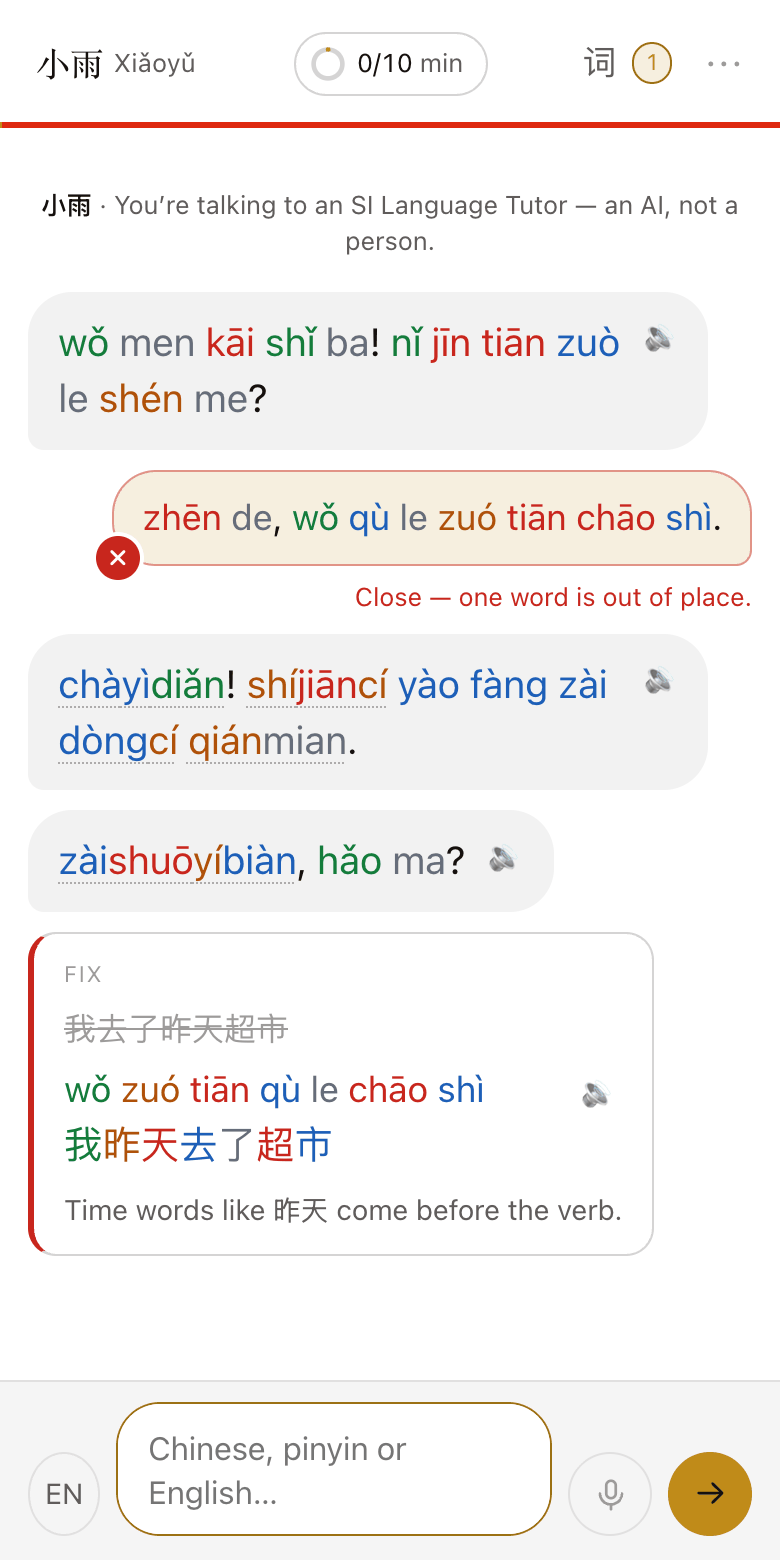
A human tutor does this well. So does a patient friend. We make Language Tutor, an AI tutor built for this part: you speak, it answers out loud, it corrects what came out wrong and has you repeat it, at any hour. In its drills it can draw the pitch of your voice next to the tone you were aiming for. That part is still in beta, and it coaches; it does not grade. It teaches Mandarin only, for now.
What it costs
| Plan | A month | Minutes a month |
|---|---|---|
| Light | $25 | 300 — about 10 a day |
| Daily | $45 | 600 — about 20 a day |
| Immersion | $85 | 1,350 — about 45 a day |
The first 10 minutes are free. More minutes can be added at any time: any whole amount from $10 to $200, 10 minutes per dollar. Minutes measure how much the AI is used rather than the clock; our Terms say how they are counted.
Try the drill with someone listening
Say today’s row to Language Tutor and hear what comes back. The first 10 minutes are free.
Start — 10 free minutes